
New nesting tower gives swifts and house martins a lifeline
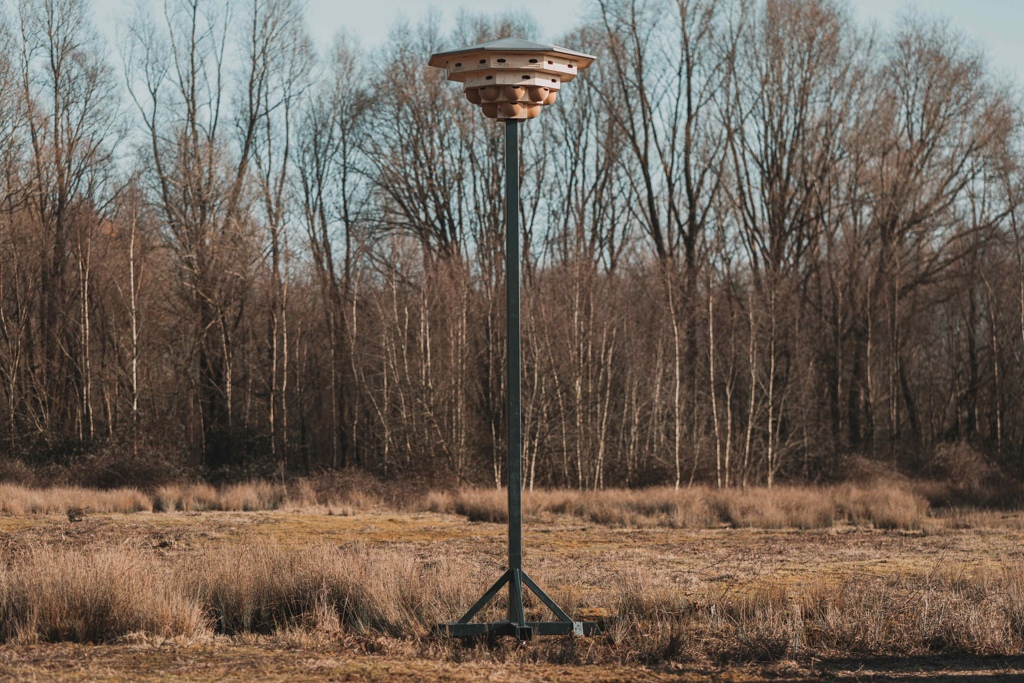
Swift and house martin tower © Chris Fairchild
A specially designed nesting tower has been installed at Blashford Lakes Nature Reserve to support struggling populations of swifts and house martins.
It marks Hampshire & Isle of Wight Wildlife Trust’s first nesting tower across its estate, and provides much-needed secure nesting sites for these red-listed bird species.
Swifts and house martins have experienced significant population declines in recent decades, due to habitat loss and a reduction in suitable nesting sites. The UK breeding population of swifts have declined by 66 percent between 1995 and 2022, while house martins have declined by 44 per cent.
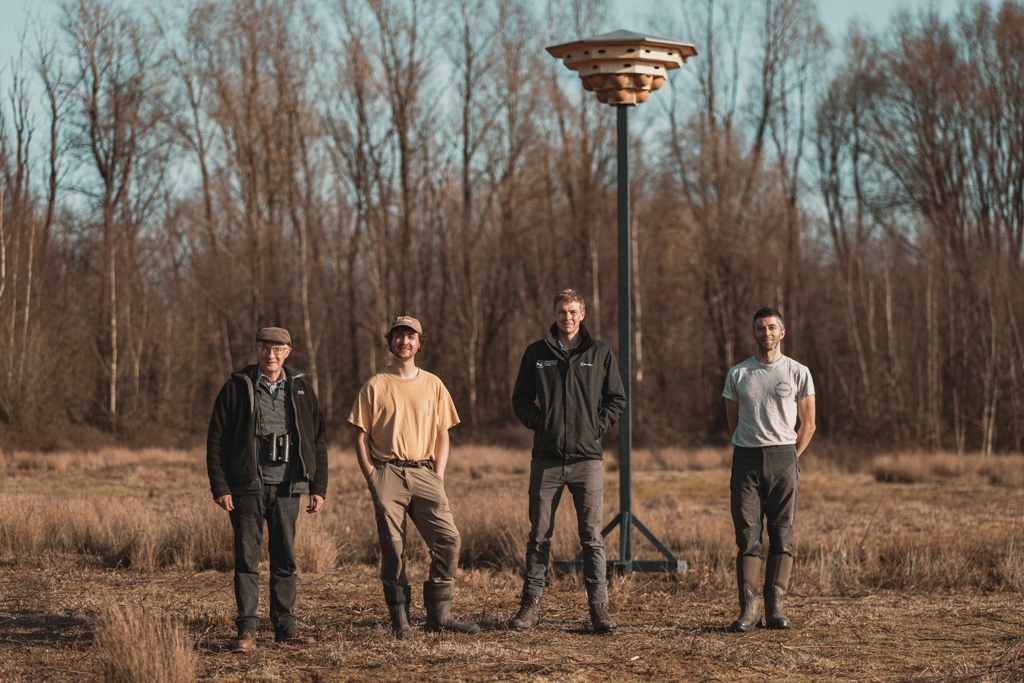
LtR Tim Norris, Jack Medley and contractors from Peak Boxes © Chris Fairchild
Standing five metres tall, the tower features 23 swift boxes and 12 house martin cups, offering much-needed breeding opportunities. It incorporates ventilation to keep the nests cool during warmer months and is equipped with solar panels and speakers to play pre-recorded bird calls, attracting young birds searching for a nesting site to settle into.
“This is the first nest tower of its kind across the Trust’s entire estate,” said Jack Medley, Reserves Officer at Hampshire & Isle of Wight Wildlife Trust. “It marks a significant milestone in our ongoing efforts to help swifts and house martins, two remarkable species facing serious challenges. The tower is part of our commitment to providing innovative solutions that help these birds thrive.”
Swifts and house martins migrate from sub-Saharan Africa to breed in the UK, depending on suitable nesting sites and an abundant insect population. Historically, swifts have nested in the roofs of older buildings, but modern renovations are sealing up access points, leaving them without suitable breeding spaces. The new tower mimics natural nesting conditions, offering a secure, predator-free location, giving these birds a vital lifeline.
Jack says: “Swifts and house martins are remarkable birds that complete incredible migrations from Africa each year. By providing secure nesting spaces at Blashford Lakes Nature Reserve, we’re giving them a fighting chance to stabilise and recover. It’s fantastic to see this conservation effort come to life.”
The tower also provides easy access to a rich supply of insects, their primary food source. The wetlands, reed beds, and woodlands at Blashford Lakes Nature Reserve create perfect conditions for insects to flourish, ensuring the birds have the resources they need to thrive during the breeding season.
Bringing this vision to life required a combination of expert knowledge, skilled design, and generous support, as Jack explains: “I’m incredibly proud of this project and would like to extend a heartfelt thank you to everyone who made it a reality. A special thank you goes to Hampshire Ornithological Society for their generous funding, Hampshire Swifts for their expert advice and guidance, and to Peak Boxes for their craftsmanship.
“This tower represents a huge step in our ongoing conservation efforts to protect these vulnerable species, and we couldn’t have achieved it without the support of our partners and the dedication of so many involved.”
Located next to the site’s largest Lake, Ibsley Water, the tower is viewable near Goosander hide. It will be closely monitored, with data collected on nest occupancy each year.
Species facts
- Swifts spend almost their entire lives in flight – eating, sleeping, and even mating on the wing.
- Both swifts and house martins migrate over 3,000 miles each way from Africa to breed in the UK each year.
House Martins
- House martins can be identified by their plump bodies, short forked tails, broad wings and distinctive white rump.
- House martins can often be seen swooping over the water at Blashford Lakes Nature Reserve
- They have a glossy blue-black upper, with white underparts and rump.
- They also have a short, forked tail and board pointed wings.
- Length is 12cm
- Wingspan is 28cm
- See them during April-September
- They have 2-3 broods per year, each with 4-5 eggs.
- The young from an early brood help to feed young of a later brood.
Swifts
- Swifts are known for their high-speed aerial acrobatics as they hunt on the wing.
- Their distinctive piercing screeches can be heard during the breeding season whilst they race between buildings in urban areas.
- They are dark sooty brown in colour.
- They have a short forked tail, and long scythe shaped wings.
- Length is 16cm
- Wingspan is 44cm
- See them from April-August
- They have 1 brood per year with 2-3 eggs
- Young swifts do press ups to strengthen their wings before their first flight.
- Swifts are fast fliers reaching up to 70mph
About the tower
- The five meter tower offers 23 swift boxes and 12 house martin cups for nesting.
- A solar powered speaker plays swifts and house martin calls to attract the birds.
- Built-in ventilation keeps nest chambers cool.
- Slots under the roof of the tower provide roosting sites for bats.
About Hampshire and Isle of Wight Wildlife Trust
Hampshire & Isle of Wight Wildlife Trust is committed to creating a wilder future by 2030, where nature is recovering, wildlife is returning, and ecosystems are being restored across our counties. With the support of more than 29,000 members, we want to see many more people on nature’s side. We aim to engage 1 in 4 people, encouraging them to take action for nature by becoming part of Team Wilder.
We want to see at least 30% of land and sea transformed into wilder places where nature is recovering by 2030. We are already doing this by expanding our nature reserves, ensuring land outside them is working for wildlife, restoring missing species and campaigning for the right policies to drive the change we need. But we need much more of this rapid, positive action to tackle the climate and ecological crises and to create a wilder future for us all.
We’re part of the UK-wide movement of 46 Wildlife Trusts, all standing up for the natural world. Together, we are the nation’s most active and influential nature conservation partnership. Each Trust works within its local community to inspire people and bring about positive change. Discover and protect local wildlife on your doorstep with Hampshire & Isle of Wight Wildlife Trust www.hiwwt.org.uk